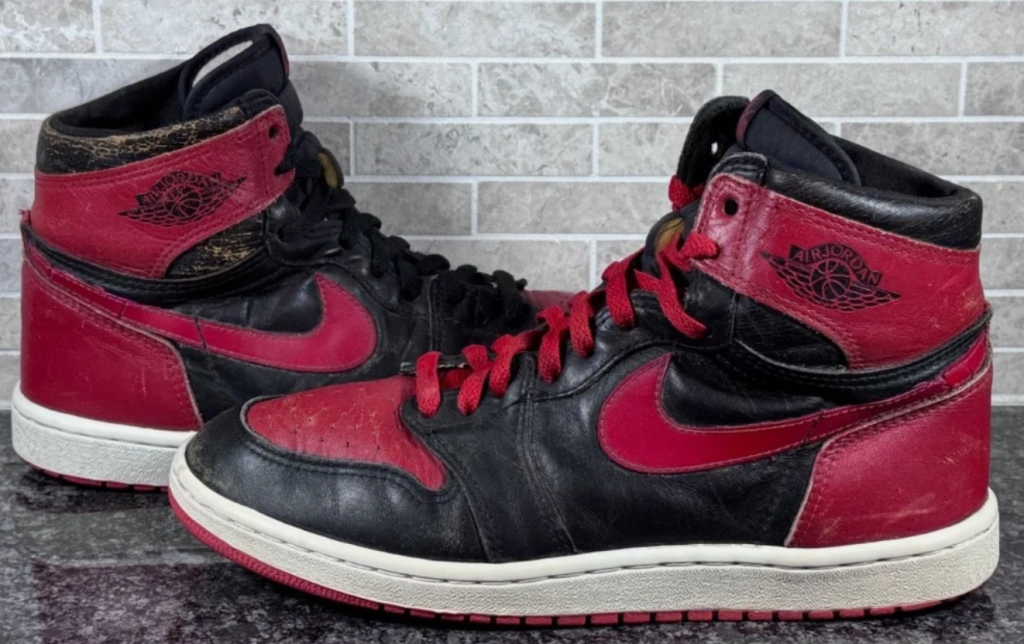
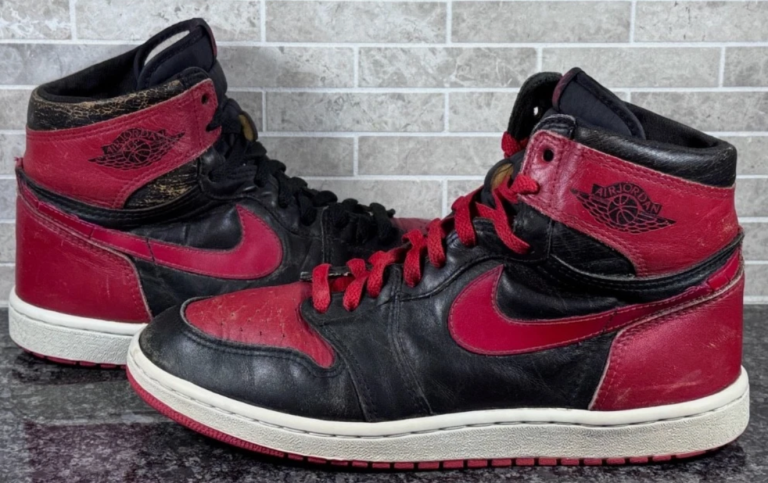
The Air Jordan 1 “Bred” is one of the most storied sneakers ever made. Dressed in a stark black and varsity red colorway inspired by the Chicago Bulls’ team colors, it arrived during Michael Jordan’s rookie season and became the focal point of one of the most effective marketing campaigns in sports history. More than just a basketball shoe, the Bred AJ1 helped establish the entire concept of athlete-driven sneaker culture and turned a $65 pair of high-tops into a symbol of rebellion, aspiration, and style that endures four decades later.
The story begins in 1984, when Nike signed a 21-year-old Michael Jordan to a five-year, $2.5 million endorsement deal — three times larger than any NBA shoe contract at the time. The signing was itself improbable: Jordan reportedly preferred Adidas, and it took the encouragement of his mother, Deloris, to convince him to even attend the Nike meeting. Once there, Nike’s pitch was unlike anything else in the industry. Rather than slotting Jordan into an existing shoe line, the company proposed building an entire brand around him — a first in basketball. Nike’s creative director, Peter Moore, was tasked with designing both the shoe and its visual identity.
Moore’s design for the Air Jordan 1 was deliberately bold. He chose a high-top silhouette built on a full leather upper with a prominent Nike Swoosh along the side panel and a distinctive “Wings” logo on the ankle collar — a mark he famously sketched on a napkin during a flight, inspired by a set of plastic captain’s wings a flight attendant had given to a child. The shoe featured Nike Air cushioning in the heel, a technology that was still relatively new to basketball footwear at the time. But it was the color blocking that made the Bred stand out: solid black and red with no white, a combination that looked nothing like the overwhelmingly white sneakers that dominated NBA courts in the mid-1980s.
That color scheme ran headlong into the NBA’s uniform policy, which required player footwear to be at least 51 percent white and to match the shoes worn by teammates. The widely told version of what happened next — that the NBA “banned” the Air Jordan 1 and fined Jordan $5,000 per game — is one of sneaker culture’s most persistent myths, and the reality is more nuanced. In the fall of 1984, before the AJ1 was ready for production, Jordan wore a black-and-red Nike Air Ship (a similar-looking but distinct model) during preseason games. It was this shoe, not the Air Jordan 1, that drew the NBA’s initial enforcement. A letter from NBA executive vice president Russ Granik to Nike, dated February 25, 1985, confirmed that Jordan’s “red and black NIKE basketball shoes” violated league rules, referencing a game “on or around October 18, 1984.”
Nike saw the controversy as a marketing gift. The company shot a television commercial showing Jordan bouncing a basketball as the camera panned down to his black-and-red AJ1s, which were then obscured by black bars. The voiceover declared that the NBA had “thrown them out of the game” but that “the NBA can’t stop you from wearing them.” The ad turned a uniform violation into a narrative about defiance and individuality, and it worked spectacularly. Consumers who might never have noticed a basketball shoe were suddenly drawn to the idea of owning the sneaker that was “too bold” for the league. The original sales projections had been modest — Nike expected to sell around 100,000 pairs and generate $3 million over several years. Instead, the Air Jordan line brought in roughly $126 million in its first year alone.
As for the Bred colorway itself, photographic evidence suggests Jordan rarely (if ever) wore the black-and-red AJ1 during official NBA regular-season games. The one confirmed on-court appearance of the Bred AJ1 was at the 1985 NBA Slam Dunk Contest during All-Star Weekend in Indianapolis, where normal uniform rules did not apply. For regular-season play, Jordan primarily wore white-based AJ1 colorways — the “Chicago” (white/red/black) and others — that were closer to compliance with league policy. None of this diminished the Bred’s mystique. If anything, the scarcity of game-worn evidence only deepened its legend, and the “Banned” narrative became inseparable from the shoe’s identity.
The Bred was part of the very first public release of the Air Jordan 1 line in April 1985, alongside the Black Toe colorway. Both arrived at an original retail price of $65, a premium figure for basketball shoes at the time. The Chicago colorway followed several months later in September 1985, with additional colorways — including the Royal, Shadow, Neutral Grey, and the Metallic series — rolling out through late 1985 and into early 1986. Peter Moore’s design language — the bold color blocking, the Wings logo, the prominent Swoosh — established a visual template that would define sneaker culture for generations. It is worth noting that the AJ1 is the only Air Jordan model to feature the Nike Swoosh on the side panel; subsequent models replaced it with Jordan Brand’s own Jumpman logo, which Moore also co-designed.
In the decades since, the Bred has been retroed multiple times, and each release has met with enormous demand. Notable retros include the 1994 and 2001 versions (both with original Nike Air branding), the 2011 “Banned” edition (which leaned into the mythology with a red “X” on the heel and the October 18, 1985 date on the insole), the 2013 and 2016 retros, and the 2019 release that returned to more faithful OG proportions. In February 2025, Jordan Brand released the Air Jordan 1 High ’85 “Bred” for the model’s 40th anniversary, limited to approximately 23,000 pairs distributed across only 23 select retailers in the U.S. — making it one of the most limited Jordan 1 drops in recent memory. A wider Holiday 2025 release followed under a separate style code, featuring the ’85 silhouette with its taller collar, slimmer toe box, and vintage construction details.
On the collector market, 1985 originals command serious prices. Deadstock OG pairs can reach well into five figures depending on size and condition, while game-worn or autographed examples have sold at auction for hundreds of thousands of dollars. Even modern retro releases hold strong resale value, a testament to the enduring demand for this colorway.
The Air Jordan 1 “Bred” matters because it sits at the intersection of sport, design, marketing, and culture in a way that few products ever have. It was the shoe that proved a sneaker could be more than equipment — it could be a statement, a story, and an identity. Peter Moore’s design gave it form. Michael Jordan’s talent gave it credibility. Nike’s marketing gave it mythology. And four decades of collectors, players, and enthusiasts have given it a legacy that shows no sign of fading.
Notable Retro Releases (Reference)
| Year | Style Code | Retail | Notes |
| 1985 | 4281 | $65 | Original release (April 1985) — Peter Moore design, Nike Air branding |
| 1994 | 130207-061 | $100 | First retro — Nike Air tongue |
| 2001 | 136066-061 | $100 | Retro with Nike Air branding |
| 2009 | 332550-061 | $175 | Defining Moments Pack — first with Jumpman branding |
| 2011 | 432001-001 | $175 | “Banned” edition — red X on heel, Oct 18 date on insole |
| 2013 | 555088-023 | $160 | Return of Nike Air on tongue, High OG silhouette |
| 2016 | 555088-001 | $160 | Remastered “Banned” — tumbled leather |
| 2019 | 555088-062 | $160 | OG-proportioned retro, wide release |
| 2025 (Feb) | DZ5485-061 | $250 | High ’85 “Bred” — 40th anniv., ~23K pairs |
| 2025 (Hol) | IQ6083-067 | $250 | High ’85 SP “Bred” — wider Holiday release |